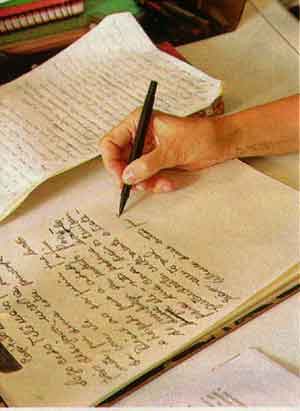
Last Chapter of the transcript of the Creative Writing Workshop taught Victor Conde in 2010. Continuation of this post .
Enjoy!

Narrator
There are two types of narrators that are essential when learning to write: Male omniscient narrator witness:
· The is the omniscient narrator who knows everything, not present in the story goes and never writes in third person. It's kind of God does not intervene in l plot, but who knows everything and knows what goes through the mind of every character. The narrator is easier to use if we want to put all the data you have of history.
· The witness narrator is a character that is part of the story, and tells first hand their experiences. The narrator witnesses the events closer to the reader, does not distance itself as much as the narrator omniscient. If we have a narrator witness, or whatever it is, a narrator character, we should speak as he does to show that we are really seeing the world through their eyes, if a depressed person will see a sad and gray , if a character says many bad words can be included in our text (in moderation, it may displease the reader.) Do not forget that the character must fit the place and time in our history. As the witness, the narrator makes the reader from getting deeper into the story and more easily become yours. The problem is that no witness narrator knows everything, is not God, therefore can make mistakes in telling the facts. With the narrator witness you can not change the scene to tell what happens beyond the character that tells everything. Therefore, we clarify that the narrator witness does not serve if we want to tell a story with only one star coral: if that happens, we can always jump to another character-narrator to tell that part of the story is away from the first-person narrator.
The Narrative in the past n is genetically ingrained in our brain, because it reminds us of when cavemen gathered around the fire so that those who were hunting adventures tell who lived (all passed).
last time help writing romantic and historical texts and science fiction. By counting in the past, wanted in mythic elements. It does not give a totally objective facts because they supposed to be a memory of narrating.
In this immediacy is achieved, which in the past will not get well because he is a buttoned fact that readers can not affect us. The stories of fear, for example, are more effective if written in mind that if written in the past.
Horror Stories For long should also use a style that resembles the newspaper, because we always give the impression that reading it must be true.

Genres
The a novel genres are simple labels that are put to the stories to better understand what is going to read it before. When a writer has enough experience is when you should put squarely in the genre by having to show them and then sell them to a editorial. If what we write is not for publication, but only for fun or practice, we should not worry about the genres of history.
genres prepare the reader to the reader about the book you are buying. For non-professional writers, genres also help when the publishers know who they are.
How do we get into a genre? It is easy to adapt to the tastes of the reading of the person who writes all my life if I have read science fiction, the most give me easy is science fiction, because all my life I used to my brain to this genre and is the most control.
genera are not self-exclusive , but can be combined: historical novel + terror, + romance, + erotic etc. The more elements of different genres have it history, the richer.
But if you change the gender in the middle of the novel is disruptive to the reader. Did not I read a story only historical and Martians have just appeared now?

Collection of all post the Creative Writing Workshop:
1 º Introduction
2 º Characters
3 º Things to know
For my part, let the copy paste (although if you're going to hang it anywhere else, I'd like pusierais the link here.) I think it's an interesting topic to read and you can learn many things. "Setting limits to culture? Nah